




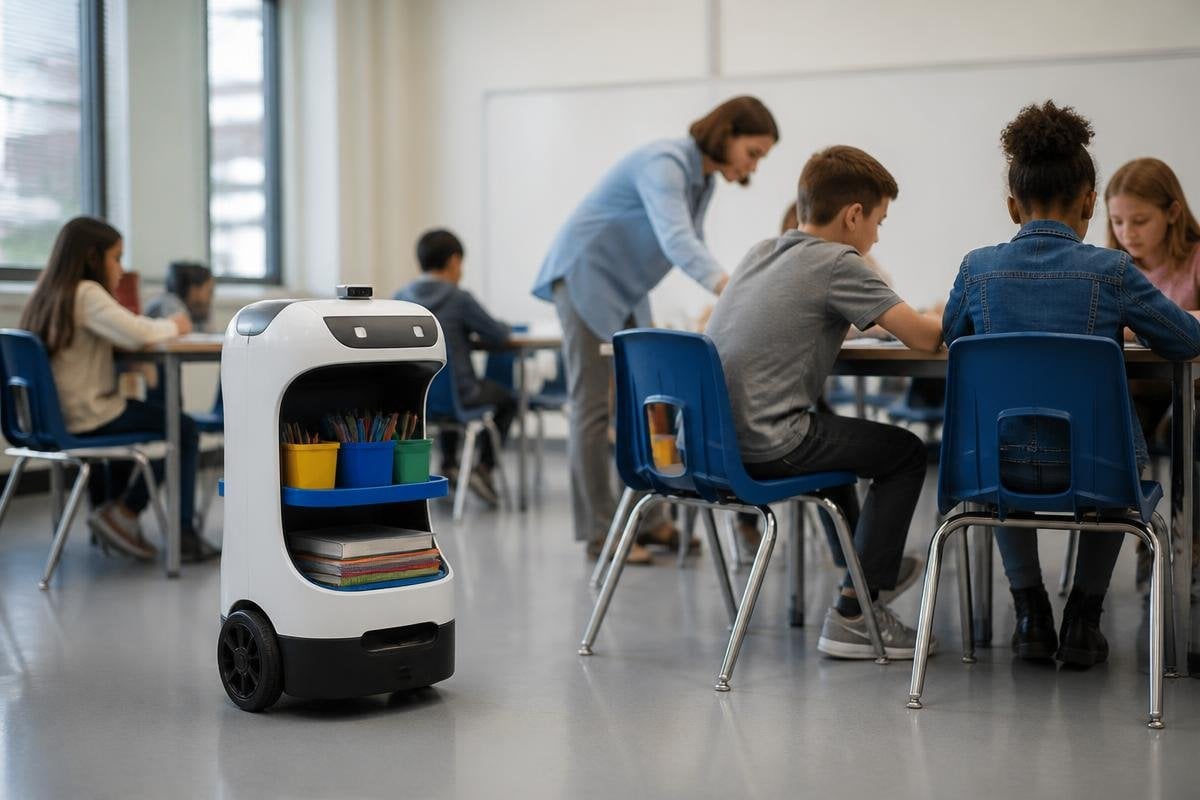
A classroom robot won’t need to look like a person to be useful. A wheeled unit that carries books, guides a small group through a coding task, or checks room conditions could change how teachers spend their time.
The better question is not whether schools will buy robots. It’s which jobs are safe, clear, and useful enough to give to a machine.
- Carrying materials between rooms
- Giving repeatable practice tasks
- Showing students how sensors and software work
Start with jobs teachers repeat
Clear steps and a clear result make a task suitable for a robot. Carrying a tray from a storage room to a classroom fits that pattern. Running the same spelling exercise for several groups can free the teacher to work with one student.
The teacher remains in charge. After its narrow task, the robot waits for a person when the situation falls outside its instructions.
Floor cameras can read markers. Wheel motors move the robot between set points. With a tablet, it can show the next activity without asking the teacher to repeat the same directions.
This matters because classroom work changes from minute to minute. A machine that needs a fixed path and quiet room may work during a planned activity, then struggle when desks move or a student leaves a bag in its way. Schools need machines that fail in a clear and safe manner.
Robots as teaching equipment
The robot itself can become part of the lesson. Students can test how a distance sensor reacts to a chair, write code that changes the robot’s speed, or compare a planned route with the path the wheels actually take.
Those tasks connect software to something visible. A faulty command may send the robot toward the wrong marker. A low battery may stop the activity halfway through. Students can see the result, inspect the code, and try a fix.
The hardware also gives teachers a way to discuss limits. A robot may detect an object without knowing what the object is. It may follow a route without understanding why the route matters. That gap helps students separate sensing, decision-making, and movement.
Teachers planning a robotics lesson can use robotics reports from Robot24.com to compare classroom machines with systems tested in research and industry. Those reports give the next section a clear starting point: the limits schools need to plan for.
The limits schools need to plan for
Privacy comes first. A robot with a camera or microphone can collect information about children, even when the school only wants it to follow a route. A school needs a clear answer about what the machine records, where it stores the data, and who can access it.
Safety also depends on the room. A robot with wheels needs a safe speed, a visible stop control, and a route that avoids stairs. A robot arm needs limits on force and movement. The manufacturer’s safety notes should become part of the classroom plan, not a document left in a box.
Teacher workload matters just as much. Charging, software updates, repairs, and lesson setup all take time. If one teacher must fix the robot between every activity, the machine has moved work around rather than removed it.
I’d start with a small classroom robot that has no camera, a physical stop button, and a task students can inspect in one lesson.
A practical starting plan
Before a school buys or trials a robot, check these points:
- Name one task: Choose a repeatable job with a clear result, such as moving materials or running a coding exercise.
- Set the human handoff: Decide when the teacher takes control and how the robot signals that it needs help.
- Check the room: Test doors, floor changes, desk layouts, charging space, and emergency access.
- Limit data: Turn off cameras and microphones when the lesson does not need them, then confirm what the robot stores.
- Measure teacher time: Record setup, charging, cleaning, and repair work alongside the lesson benefit.
This process gives the school a useful answer even when the robot fails. If the task remains safe, easy to inspect, and manageable for staff, the trial has a sound base. If the machine needs constant attention, a simpler tool may serve the class better.
The classroom of the future will likely begin with quiet machines doing narrow jobs. The schools that gain from them will be the ones that define the task, protect the children’s data, and keep a teacher in control.
